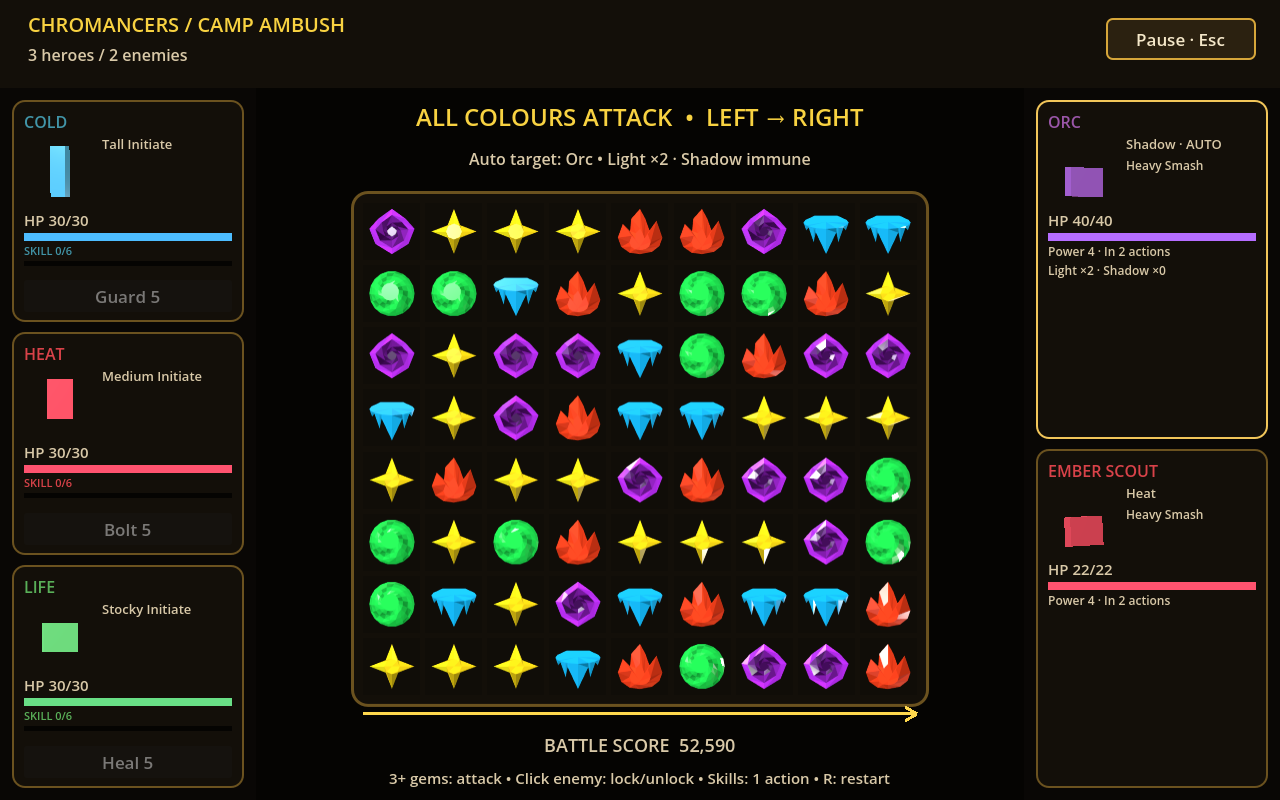
The combat screen had too many little instructions asking for attention. A Target button sat on every enemy card, even though the card itself could do the job. Now I click an enemy to lock on, and click it again to let the game choose. Auto targeting looks for the weakest enemy of the gem's opposite color before falling back to the weakest enemy still standing. Yellow naturally seeks purple. The color relationships finally do something I can feel while playing.
I also wanted to see the fifteen starting Initiates in action: five colors, three body shapes, and a squad drawn at random. For this pass, shape changes the silhouette, while color gives each hero an action. Heat hits, Cold guards, Life heals, Light boosts the next gem attack, and Shadow steals health. These are playable test abilities, with numbers I expect to change.
The portraits took a useful detour. I asked for animated 3D fighters, then realized the first version looked more like character art than the experiment needed. We stripped them back to colored boxes: tall and narrow, balanced, or short and wide. They lunge to attack, lift for a skill, and recoil when hit. Surprising how much a box can say once it moves. I should have remembered this from Portal. Boxes have emotions.
That led to the question I most want to play with. If I bring a yellow hero, shouldn't clearing yellow gems build toward that hero's action? We're testing a six-gem meter for each hero. Two heroes of the same color both charge from the same clear, but each spends their own meter. It makes squad color a choice with consequences on the board. I still don't know whether six gems feels right, or whether duplicate colors will be too good. That's what the next fights are for.